

How to Price a Unique Country Property in the Sierra Foothills

Pricing a typical suburban home can be relatively straightforward.
An agent may find several recent sales in the same neighborhood with similar square footage, floor plans, lot sizes, and construction. After adjusting for condition and upgrades, a reasonable price range begins to emerge.
Country properties are different.
What happens when your home has five acres, a barn, irrigation water, a workshop, a pond, owned solar, an ADU, cross-fencing, a view, and enough privacy to wander outside in your bathrobe without becoming neighborhood news?
There probably is not another property exactly like it.
That does not mean your property cannot be valued. It means pricing requires more than entering the square footage and ZIP code into an automated calculator.
For homeowners in Auburn, Penryn, Newcastle, Loomis, Meadow Vista, Grass Valley, Nevada City, Colfax, Foresthill, and the surrounding Sierra Foothills, the land and rural improvements may be a significant part of the property’s appeal.
The challenge is determining how much the market will pay for the complete package.
Why Automated Home Estimates Often Miss the Mark
Automated valuation tools can be useful as a starting point, but they rely heavily on recorded property data and patterns from previous sales.
An algorithm may recognize:
- Square footage
- Bedroom and bathroom count
- Parcel size
- Year built
- Recorded sales
- General location
It may not understand:
- How much of the acreage is usable
- Whether the land is steep or level
- The condition and usefulness of a barn
- Whether a workshop has power
- The reliability of the well
- The value of PCWA or NID irrigation water
- Whether a pond holds water year-round
- The quality of the fencing
- Trailer and emergency-vehicle access
- Whether an ADU is permitted
- The difference between a panoramic view and a view of the neighbor’s equipment pile
- How buyers respond to the property in person
Two five-acre properties can have dramatically different values.
One may have level, irrigated pasture with good access and functional outbuildings. The other may consist largely of steep, wooded terrain with limited access and little usable space.
An automated estimate may see two five-acre parcels. A rural buyer will not.
Start With the House, but Do Not Stop There
The house remains an important part of the valuation.
A pricing analysis should consider:
- Finished living area
- Bedroom and bathroom count
- Age and architectural style
- Condition
- Quality of construction
- Renovations
- Floor plan
- Energy efficiency
- Views from the house
- Indoor and outdoor living areas
- Garages and parking
- Pool, spa, or outdoor kitchen
However, country-property buyers are often purchasing a lifestyle as much as a house.
A beautifully remodeled home may not meet a buyer’s needs if the land is unusable, the trailer cannot reach the barn, or there is no reliable source of water.
A more modest house may receive strong interest when the property offers privacy, excellent land, functional improvements, and the infrastructure needed for the buyer’s plans.
Usable Acreage Matters More Than the Number Alone
One of the most common pricing mistakes is assuming every acre contributes equally to value.
Buyers will want to know:
- Is the land level, rolling, or steep?
- How much is cleared?
- Is it suitable for horses or livestock?
- Can it support a garden, orchard, or vineyard?
- Is the soil rocky or productive?
- Does the land drain well?
- Is there room for an arena, pool, ADU, or workshop?
- Can vehicles and equipment reach the important areas?
- Is the acreage fenced or cross-fenced?
- How much maintenance will it require?
A smaller parcel with excellent usability may be more valuable to a particular buyer than a much larger parcel that is difficult to access or maintain.
This is why pricing should reflect the quality and utility of the land, not simply the acreage printed in the public record.
Water Can Be a Major Value Driver
Water is one of the most important considerations when evaluating a Sierra Foothills property.
Depending on the location, a property may have:
- A private well
- Public water
- PCWA irrigation water
- NID irrigation water
- A holding tank
- A shared well
- A pond
- Seasonal water
- Multiple sources of water
A productive well with clear records may give buyers confidence. Irrigation water can be particularly valuable for pasture, gardens, orchards, vineyards, landscaping, or fire protection.
The pricing and marketing should consider:
- Well production and testing history
- Water-storage capacity
- Irrigation-water availability
- Delivery schedule
- Monthly or annual costs
- Distribution throughout the property
- Pumps, tanks, and filtration systems
- The condition of irrigation lines
- Pond reliability and permitted use
Simply advertising “irrigation water available” may not be enough. Buyers want to understand how the water serves the property and whether it supports their intended use.
Barns, Shops, and Outbuildings Need Individual Evaluation
Sellers sometimes assume the cost of constructing a barn or workshop can be added directly to the home’s value.
Unfortunately, market value and construction cost are not always the same.
A $150,000 outbuilding does not automatically increase the sale price by $150,000. Its contribution depends on how useful and desirable it is to likely buyers.
Questions to consider include:
- Is the structure permitted?
- What is its size?
- What is its condition?
- Does it have power or water?
- Can large vehicles reach it?
- Is it designed for horses, equipment, storage, or business use?
- Does it have safe flooring and ventilation?
- Is there adequate clearance?
- Does it fit the property and local market?
- Would most likely buyers use it?
A well-designed workshop may be extremely valuable to someone with collector cars, equipment, or a home-based hobby.
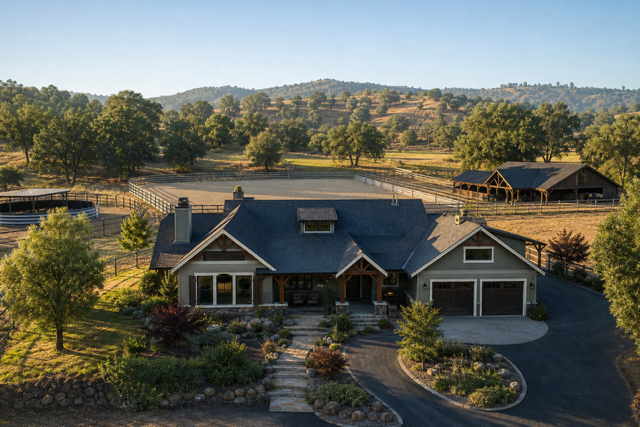
A functional horse barn with stalls, water, power, hay storage, turnout, and trailer access can set a property apart for an equestrian buyer.
A deteriorating structure with safety or permit concerns may contribute less value and could even become a source of buyer hesitation.
Equestrian Improvements Require the Right Buyer
Horse-property improvements are highly specialized.
They may include:
- Barns and stalls
- Tack and feed rooms
- Arenas
- Round pens
- Paddocks
- Pastures
- Shelters
- Wash racks
- Fencing and cross-fencing
- Trailer parking
- Direct or nearby trail access
These features can be valuable, but only if the marketing reaches buyers who understand and want them.
An arena may not mean much to a buyer who only wants privacy and a garden. To an equestrian buyer, its size, footing, drainage, access, and condition may be a major purchasing factor.
Pricing a horse property requires understanding both the improvements and the people searching for them.
It also requires honest evaluation. A fenced area is not automatically a safe horse pasture, and a metal outbuilding is not necessarily a horse barn.
Accurate descriptions build trust and help attract the right buyer.
Privacy, Views, and Location Still Matter
Not every valuable feature can be measured with a tape measure.
Buyers may pay more for:
- Long-range foothill or valley views
- A private setting
- A quiet road
- Distance from neighboring homes
- Proximity to Auburn, Roseville, or Sacramento
- Access to trails and recreation
- A location below heavy snow
- Convenient freeway access
- Proximity to shopping and medical care
- A desirable school district
- A peaceful setting without excessive road noise
However, privacy can come with tradeoffs.
A long private road may feel peaceful but require maintenance. A secluded location may have limited internet access or a long emergency-response time. A wooded setting may create wildfire and insurance concerns.
Pricing should consider both the emotional appeal and the practical reality of the location.
ADUs and Guest Quarters Need Careful Review
An accessory dwelling unit can add significant appeal for buyers who want:
- Multigenerational living
- Guest accommodations
- Caregiver housing
- A private office
- Potential rental income
- Space for adult children
Before assigning value, verify what the property actually includes.
Important questions include:
- Was the structure permitted?
- Is it recognized as living area?
- Does it have a kitchen and bathroom?
- How is it heated and cooled?
- Does the septic system support it?
- Does it have separate utilities?
- Is it attached or detached?
- What is its condition?
- Can it legally be rented?
An attractive guest space may still have value even if it is not recognized as a permitted ADU, but it should not be marketed inaccurately.
Documentation helps the agent, buyer, appraiser, and lender understand what is being sold.
Why the Closest Sale May Not Be the Best Comparable
With a unique rural property, the most useful comparable sale may not be located around the corner.
Fannie Mae’s appraisal guidance allows appraisers to use sales located farther from the subject property when those properties are better indicators of value. The appraiser must explain why the comparables were selected. Fannie Mae also recognizes that rural markets can have limited sales data, making the analysis more challenging. Its guidance emphasizes selecting properties that are locationally, physically, and functionally similar.
That means a relevant comparable might be:
- Farther away
- Older than the most recent neighborhood sale
- In a nearby foothill community
- Similar in land use rather than exact acreage
- Similar in improvements rather than architectural style
- Chosen to demonstrate the value of a specific feature
You can review Fannie Mae’s discussion of rural appraisal challenges and its broader appraisal guidance.
The California Department of Real Estate also notes that a listing agent needs an informed estimate of value and should understand comparative valuation principles. Its Appraisal and Valuation reference provides an overview of these methods.
For some properties, one sale may help evaluate the house, another may demonstrate acreage value, and a third may show how buyers respond to a barn, shop, or ADU.
This is more thoughtful than choosing the three closest sales and averaging their prices.
Price Per Square Foot Has Serious Limits
Price per square foot can provide context, but it should not be the only pricing method for a country property.
It does not adequately account for:
- Land quality
- Parcel usability
- Water
- Views
- Privacy
- Barns and shops
- ADUs
- Pools
- Solar
- Fencing
- Road access
- Property condition
- Quality of construction
A smaller luxury home on exceptional land may sell for a higher price per square foot than a larger home with deferred maintenance and less usable acreage.
Price per square foot is a clue, not the final answer.
The Highest Price Is Not Always the Best Strategy
It is understandable for sellers to want the highest possible price. The danger comes when the list price is based on what the seller needs, what a neighbor is asking, or what an online estimate suggests rather than what buyers are likely to pay.
Overpricing can lead to:
- Fewer showings
- Longer market time
- Repeated price reductions
- Buyer suspicion
- A weaker negotiating position
- Appraisal problems
- Missed opportunities during the initial launch
A unique property may require patience because the buyer pool is smaller. That does not mean the property should be placed on the market at an unsupported price.
The strongest strategy is to price within a defensible range, present the property exceptionally well, and make sure the marketing reaches buyers who value its distinctive features.
Marketing and Pricing Must Work Together
A property cannot achieve its best price if buyers do not understand what makes it valuable.
Marketing should show more than the front of the house and a few interior rooms.
For a rural property, buyers may need to see:
- The shape and layout of the land
- Pastures and usable areas
- Barns and workshops
- Fencing and gates
- Water features
- Outdoor entertaining areas
- Views
- Trailer access
- Gardens and orchards
- The relationship between the house and outbuildings
Professional photography, video, aerial images, maps, floor plans, and detailed descriptions can help buyers understand the complete property.
As a former professional photographer, I know that rural-property photography must tell a story. The goal is not simply to document each room. It is to communicate how the property feels and how someone could live there.
A Common Sierra Foothills Seller Story
Imagine two five-acre properties outside Auburn.
Both have similarly sized homes. An automated estimate places them within a narrow value range.
The first property has steep wooded land, limited parking, no irrigation water, and an older storage building.
The second has usable pasture, PCWA irrigation water, safe fencing, a functional barn, trailer access, owned solar, and space for a garden.
On paper, the properties may initially appear similar. To a buyer looking for horses, livestock, gardening, or usable land, they are completely different.
If the second property is priced using only the first as a comparison, its important features may be undervalued.
If every improvement is added at its original construction cost, the property may be overpriced.
The correct price must balance comparable sales, buyer demand, condition, usability, and the market’s likely response to the complete package.
Information Sellers Should Gather Before Pricing
To help establish and support the property’s value, gather as much of the following as possible:
- Parcel maps
- Permit records
- Well records and test results
- Septic records
- Irrigation-water information
- Barn and outbuilding details
- ADU permits and rental history
- Solar ownership or financing documents
- Roof and HVAC records
- Generator information
- Fencing improvements
- Survey information
- Property-tax records
- Improvement dates and costs
- Easement and road-maintenance information
- Insurance and home-hardening documentation
You do not need every document before meeting with an agent. Gathering what you have can help reveal questions that should be answered before the property reaches the market.
Frequently Asked Questions
1. Is an online home estimate accurate for a property with acreage?
It may offer a starting point, but it can miss important differences involving usable land, water, improvements, condition, privacy, access, and buyer demand. A property-specific analysis is usually more appropriate.
2. Does every acre add the same amount of value?
No. Usability, terrain, access, water, zoning, location, and potential uses affect how buyers value the land.
3. Can I add the cost of my barn or workshop to the home’s value?
Not directly. Construction cost and market value are different. The improvement’s contribution depends on its condition, permits, usefulness, and buyer demand.
4. What happens if the appraisal is lower than the accepted offer?
The buyer and seller may renegotiate, the buyer may contribute additional cash, the appraisal may be reviewed or challenged when supported by relevant information, or the transaction may be affected according to the contract terms.
5. Should I get an appraisal before listing?
Sometimes a pre-listing appraisal is useful, particularly for an unusually complex property, estate, trust, divorce, or major pricing disagreement. In many cases, a detailed market analysis by an experienced rural-property agent is the first step.
Your Property Is More Than a House and an Acreage Number
Pricing a unique Sierra Foothills property requires both data and judgment.
The house matters. So do the land, water, access, privacy, improvements, lifestyle, condition, and likely buyer.
The goal is not to attach an inflated price to every feature. It is to make sure valuable features are recognized, supported, and presented to the buyers most likely to appreciate them.
If you are considering selling a country home, ranch, horse property, acreage estate, or rural luxury property, I can help you evaluate the complete property and develop a pricing and marketing strategy built around what makes it different.
Ready to learn more? Contact me for a private, no-pressure property consultation and customized market analysis.
About Lori McIntosh
Lori McIntosh is an Auburn, California REALTOR® with GUIDE Real Estate, specializing in country homes, luxury properties, acreage, equestrian properties, and downsizing throughout Auburn, Penryn, Newcastle, Loomis, Meadow Vista, Grass Valley, Nevada City, Colfax, Foresthill, and surrounding Sierra Foothills communities.
Lori lives on five acres with her own horses and understands how buyers evaluate usable land, water, fencing, barns, outbuildings, access, and the realities of country-property ownership.
Her previous career as a professional photographer gives her an additional advantage when positioning and visually marketing distinctive homes. Her background as an occupational therapist also helps her guide older homeowners through the practical and emotional decisions involved in selling a longtime property.